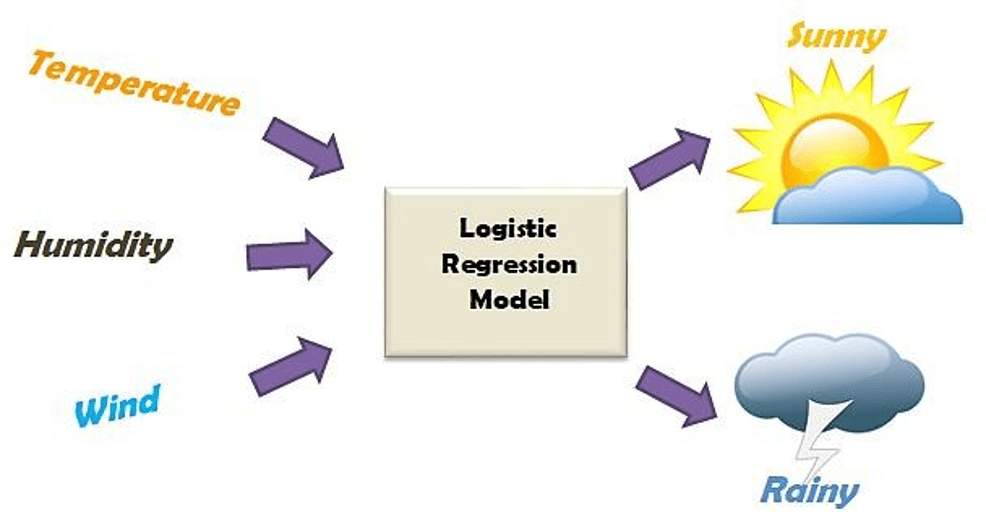
Logistic regression için test verisi olarak kanserli hücrelerin özelliklerini kullanıcaz.
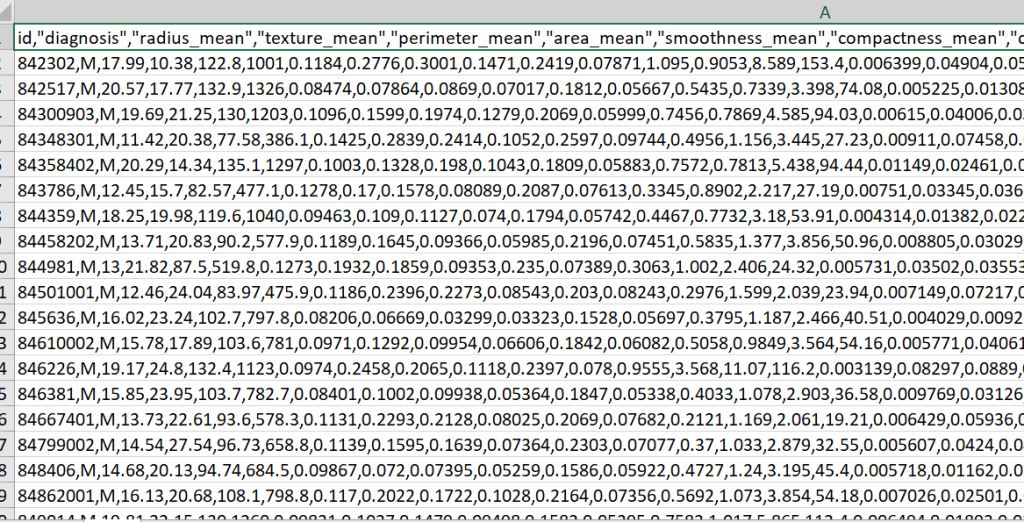
| id,”diagnosis”,”radius_mean”,”texture_mean”,”perimeter_mean”,”area_mean”, “smoothness_mean”,”compactness_mean”,”concavity_mean”,”concave points_mean”,”symmetry_mean”,”fractal_dimension_mean”, “radius_se”,”texture_se”,”perimeter_se”,”area_se”,”smoothness_se”, “compactness_se”,”concavity_se”,”concave alanlarının olduğu bir veri seti alıyoruz. |
# %% libraries
import numpy as np
import pandas as pd
import matplotlib.pyplot as plt

# %% read csv
#verinin içinden unnamed alanını kaldırıyoruz çünkü null alanlar modelde olmamalı.
data = pd.read_csv("C:/path/data.csv")
data.drop(["Unnamed: 32","id"],axis=1,inplace = True)
data.diagnosis = [1 if each == "M" else 0 for each in data.diagnosis]
print(data.info())

y = data.diagnosis.values
x_data = data.drop(["diagnosis"],axis=1)


# %% normalization
#bütün değerleri 0 ve 1 arasında bir değere dönüştürür.
x = (x_data - np.min(x_data))/(np.max(x_data)-np.min(x_data)).values


# %% train test split
from sklearn.model_selection import train_test_split
#%20'si test %80 train olarak ayırdık.
x_train, x_test, y_train, y_test = train_test_split(x,y,test_size = 0.2,random_state=42)

x_train = x_train.T
x_test = x_test.T
y_train = y_train.T
y_test = y_test.T

print("x_train: ",x_train.shape)
print("x_test: ",x_test.shape)
print("y_train: ",y_train.shape)
print("y_test: ",y_test.shape)

# %% parameter initialize and sigmoid function
# dimension = 30
# 30 tane future var. Ağırlıkları 0.01 olarak verdik.
def initialize_weights_and_bias(dimension):

    w = np.full((dimension,1),0.01)
    b = 0.0
    return w,b


# w,b = initialize_weights_and_bias(30)
#sigmoid function yazılır
def sigmoid(z):

    y_head = 1/(1+ np.exp(-z))
    return y_head
# print(sigmoid(0))


def forward_backward_propagation(w,b,x_train,y_train):
    # forward propagation
    z = np.dot(w.T,x_train) + b
    y_head = sigmoid(z)
    loss = -y_train*np.log(y_head)-(1-y_train)*np.log(1-y_head)
    cost = (np.sum(loss))/x_train.shape[1]      # x_train.shape[1]  is for scaling

    # backward propagation
    derivative_weight = (np.dot(x_train,((y_head-y_train).T)))/x_train.shape[1] # x_train.shape[1]  is for scaling
    derivative_bias = np.sum(y_head-y_train)/x_train.shape[1]                 # x_train.shape[1]  is for scaling
    gradients = {"derivative_weight": derivative_weight, "derivative_bias": derivative_bias}

    return cost,gradients

#%% Updating(learning) parameters
#update için weight,bias,x_train,y_train,learning weight gerek.
#learning weight kullanarak ne kadar hızlı öğreneceğini belirliyoruz.
#number_of_iterarion : kaç kez işlemin tekrarlanacağını belirleriz.


def update(w, b, x_train, y_train, learning_rate,number_of_iterarion):
    cost_list = []
    cost_list2 = []
    index = []

    # updating(learning) parameters is number_of_iterarion times
    for i in range(number_of_iterarion):
        # make forward and backward propagation and find cost and gradients
        cost,gradients = forward_backward_propagation(w,b,x_train,y_train)
        cost_list.append(cost)
        # lets update
        w = w - learning_rate * gradients["derivative_weight"]
        b = b - learning_rate * gradients["derivative_bias"]
        if i % 10 == 0:
            cost_list2.append(cost)
            index.append(i)
            print ("Cost after iteration %i: %f" %(i, cost))

    # we update(learn) parameters weights and bias
    parameters = {"weight": w,"bias": b}
    plt.plot(index,cost_list2)
    plt.xticks(index,rotation='vertical')
    plt.xlabel("Number of Iterarion")
    plt.ylabel("Cost")
    plt.show()
    return parameters, gradients, cost_list

#%%  # prediction
def predict(w,b,x_test):
    # x_test is a input for forward propagation
    z = sigmoid(np.dot(w.T,x_test)+b)
    Y_prediction = np.zeros((1,x_test.shape[1]))
    # if z is bigger than 0.5, our prediction is sign one (y_head=1),
    # if z is smaller than 0.5, our prediction is sign zero (y_head=0),
    for i in range(z.shape[1]):
        if z[0,i]<= 0.5:
            Y_prediction[0,i] = 0
        else:
            Y_prediction[0,i] = 1

    return Y_prediction

# %% logistic_regression
def logistic_regression(x_train, y_train, x_test, y_test, learning_rate ,  num_iterations):
    # initialize
    dimension =  x_train.shape[0]  # that is 30
    w,b = initialize_weights_and_bias(dimension)
    # do not change learning rate
    parameters, gradients, cost_list = update(w, b, x_train, y_train, learning_rate,num_iterations)

    y_prediction_test = predict(parameters["weight"],parameters["bias"],x_test)

    # Print test Errors
    print("test accuracy: {} %".format(100 - np.mean(np.abs(y_prediction_test - y_test)) * 100))

logistic_regression(x_train, y_train, x_test, y_test,learning_rate = 1, num_iterations = 300)
Yukarıdaki işlemleri tek bir metod ile yapmanın yöntemi : Logistic regression with sklearn.
#%% sklearn with LR
#yukarıdaki işlemlerin tamamını yapan metod.
from sklearn.linear_model import LogisticRegression
lr = LogisticRegression()
lr.fit(x_train.T,y_train.T)
#lr.score bize test verisinden yüzde kaç doğru olduğu bilgisi verir.
print("test accuracy {}".format(lr.score(x_test.T,y_test.T)))
 Kodlama Günlükleri